Open banking
Open banking is a regulated system that allows individuals and businesses to share their bank account data, and in some cases initiate payments directly from their accounts, with authorised third-party providers, using secure application programming interfaces (APIs). In the UK, open banking is governed by the Payment Services Regulations 2017 and overseen by the Financial Conduct Authority. Providers must be authorised by the FCA before they can access bank account data or initiate payments on behalf of account holders. Account holders retain full control. Access must be explicitly consented to, is read-only by default, and can be revoked at any time.
The two types of open banking service
The FCA distinguishes between two types of authorised open banking provider, each with a different function.
Account Information Service Providers (AISPs) are authorised to read bank account data, including transactions, balances, and payment history, with the account holder's permission. They cannot move money or see login credentials. For landlords, AISP connections are the basis of bank feed functionality: the landlord connects their bank account to a property management platform, and the platform reads incoming transactions in real time, matching rent payments to the correct tenancy automatically. This is the connection type August uses via Plaid to power automatic rent tracking for landlords.
Payment Initiation Service Providers (PISPs) are authorised to initiate payments directly from a bank account, with explicit per-transaction consent from the account holder. Rather than routing a payment through a card network, a PISP instructs the bank directly to transfer funds. For the lettings market, this means a tenant can pay rent directly from their bank account through an app, without needing to set up a standing order or enter card details. The payment moves account-to-account with no intermediary fees and typically settles faster than a card transaction.
August operates as an agent of Plaid Financial Ltd., an authorised payment institution regulated by the FCA under the Payment Services Regulations 2017 (FCA Firm Reference Number: 804718), covering both account information and payment initiation services.
How open banking is used in the landlord context
Open banking is one of the enabling technologies behind modern proptech, and it has two distinct applications for residential landlords, which are worth understanding separately.
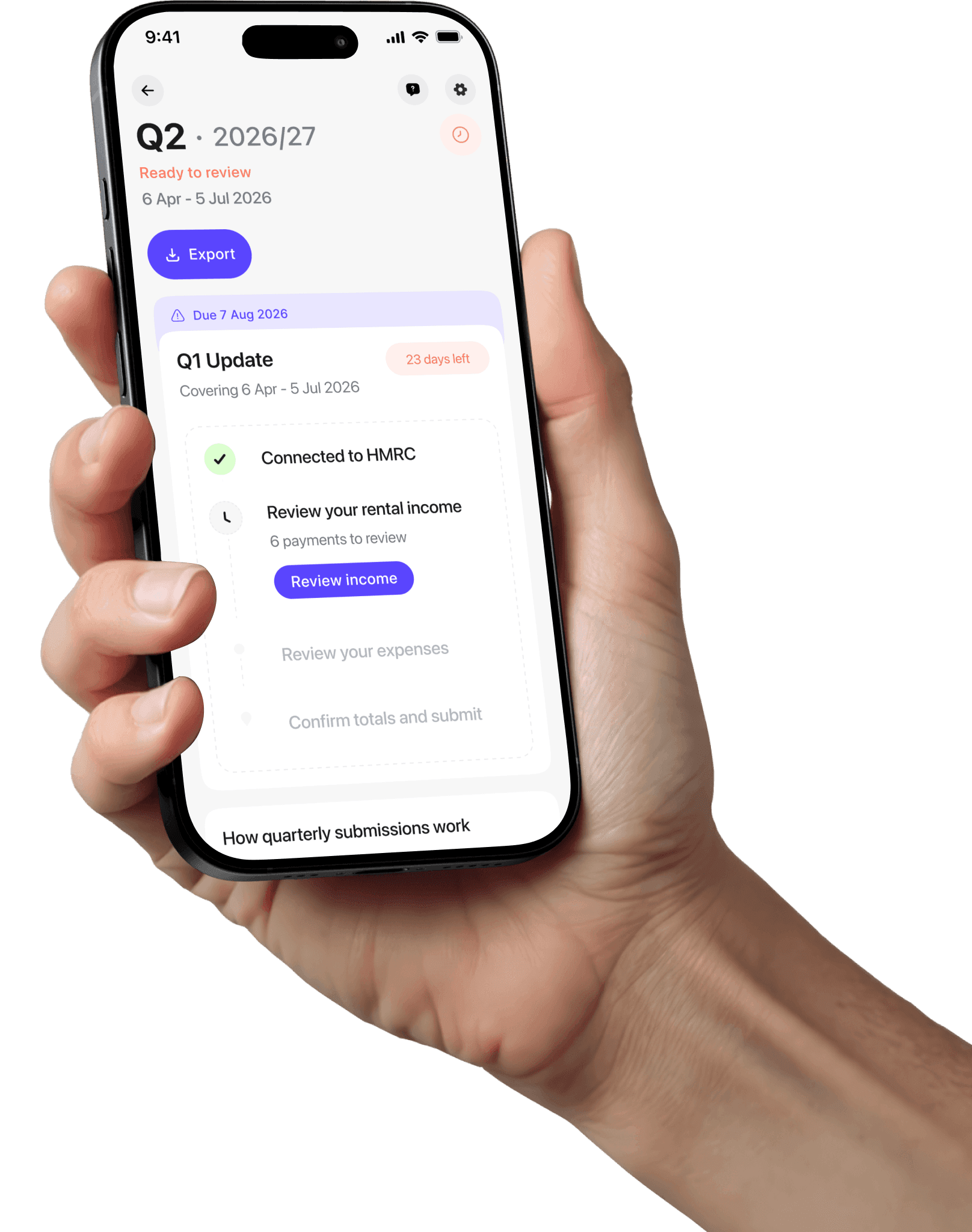
Bank feeds for rent tracking and financial records. The most common landlord use of open banking is the AISP bank feed connection. A landlord connects their bank account once to their property management platform. From that point, every incoming transaction, including rent payments, is pulled in automatically and matched to the correct tenancy. This eliminates the need to check bank statements manually, cross-reference payments with a spreadsheet, or chase tenants for confirmation. Partial payments, overpayments, and arrears are all flagged in real time. Because the income is recorded as it arrives, directly from the bank, it also constitutes a digital record for HMRC purposes. Rental income recorded this way meets the digital record-keeping requirement under Making Tax Digital without any additional steps.
From our experience working with self-managing landlords, the most significant practical benefit of bank feed open banking is not the automation itself but the MTD readiness it creates. Landlords who connect their bank account from day one of a tenancy arrive at each quarterly update deadline with complete digital income records already in place, rather than needing to reconstruct them from bank statements.
Payment initiation for rent collection. Some landlord platforms use PISP functionality to allow tenants to pay rent directly through an app, initiating a bank-to-bank transfer rather than a card payment or standing order. This removes card network fees, reduces the risk of payment failure due to expired card details, and gives landlords real-time confirmation of receipt. It is an alternative to Direct Debit and standing order arrangements, with the key distinction that each payment requires fresh consent from the tenant rather than running on a pre-authorised mandate.
Tenant referencing. Open banking is also widely used in the tenant vetting process, where prospective tenants consent to share a read-only snapshot of their transaction history with a referencing provider. This allows affordability assessments based on actual income and spending behaviour rather than self-reported figures, and typically completes in a single day rather than the several days required for traditional document-based checks. This use of open banking is initiated by referencing providers rather than by property management platforms directly.
Security and regulatory protections
Open banking connections are subject to the same encryption standards that banks use for their own systems. The account holder's login credentials are never shared with the third-party provider, authentication happens directly within the bank's own app or website. Only the data the account holder has explicitly consented to share is accessible, and access can be revoked at any time through the bank's own settings. All authorised providers must be listed on the FCA register or the Open Banking Directory; any service claiming open banking functionality without FCA authorisation is not operating within the regulated framework.
For a full explanation of how open banking works in practice, including which UK banks are supported, how the Plaid connection works, and what data August can and cannot access, our guide to open banking with August covers the complete picture.
Frequently asked questions
Does open banking give landlord software access to my bank login or passwords?
No. Open banking connections work through secure APIs that communicate directly with your bank without sharing login credentials with any third party. Authentication happens within your bank's own app or website using your normal login method (Face ID, fingerprint, or PIN). The third-party provider receives only the data you have consented to share, in read-only form, and never has visibility of your login details.
Which UK banks support open banking?
Open banking is supported by all the major UK banks, including Barclays, HSBC, Lloyds, NatWest, Santander, Halifax, Monzo, Starling, and most other current account providers. Some smaller or more recently launched providers may have limited or delayed open banking support. The specific banks compatible with any given platform depend on that platform's open banking infrastructure provider, August uses Plaid, which supports the majority of UK current accounts.
Can I revoke open banking access?
Yes. You can revoke an open banking connection at any time, either through the platform you connected to or directly through your bank's app or online banking settings. Revoking access immediately stops the platform from reading any further data from your account. Data already retrieved is subject to the platform's data retention policy.
How does open banking differ from giving my accountant read access to my bank?
Open banking is a regulated, standardised connection framework with mandatory security requirements, FCA oversight, and revocable consent built in. Giving an accountant read access to online banking typically involves sharing login credentials or setting up a named viewer on your account, a less controlled arrangement without the same regulatory protections. Open banking provides a more secure and auditable alternative.