Renters' Rights Act
PRS database registration: your region's deadline and what you must submit

Last updated date: 9 September 2026
Every private landlord in England letting under an assured or regulated tenancy must register themselves and each property on the Private Rented Sector Database, at a cost of £65 per property per year. On 9 September 2026 the government confirmed the schedule: registration opens on 15 December 2026 in the West Midlands and rolls out one region a month, with every region carrying a three-month window to comply. The last deadline, for the South West, falls on 14 November 2027. A landlord who misses their regional deadline faces a civil penalty of up to £7,000 and, more seriously, cannot obtain a possession order on almost any ground.
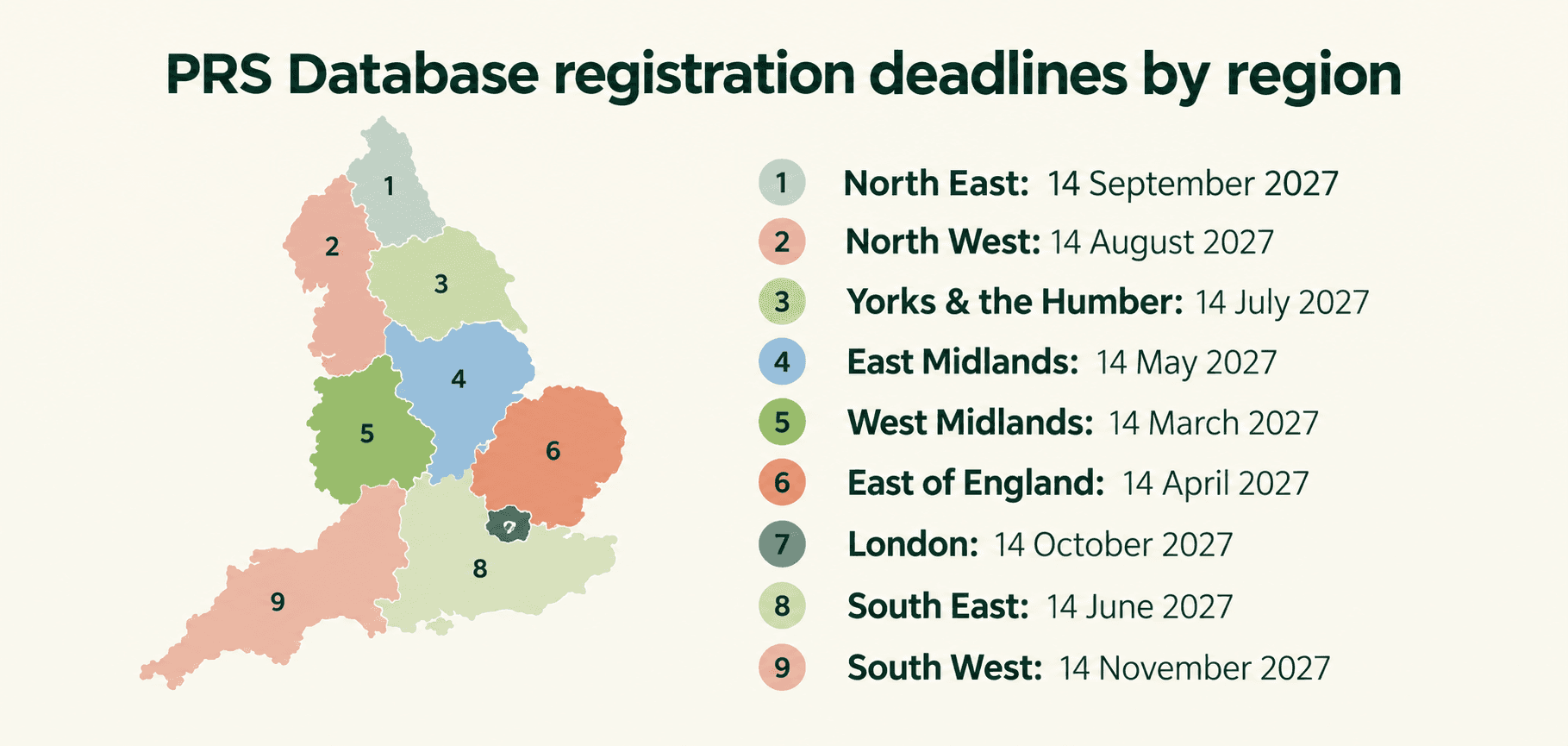
When you must register: deadlines by region
Your deadline is set by where the property is, not where you live. A landlord in London with a flat in Birmingham works to the West Midlands date.
Region | Regulations commence | Deadline to register |
|---|---|---|
West Midlands | 15 December 2026 | 14 March 2027 |
East of England | 15 January 2027 | 14 April 2027 |
East Midlands | 15 February 2027 | 14 May 2027 |
South East | 15 March 2027 | 14 June 2027 |
Yorkshire and the Humber | 15 April 2027 | 14 July 2027 |
North West | 15 May 2027 | 14 August 2027 |
North East | 15 June 2027 | 14 September 2027 |
London | 15 July 2027 | 14 October 2027 |
South West | 15 August 2027 | 14 November 2027 |
Confirmed by the Ministry of Housing, Communities and Local Government on 9 September 2026 and published on the GOV.UK Housing Hub. The statutory instrument has been laid before Parliament and, subject to approval, comes into force on 15 December 2026.
The staggering is deliberate. The government has said it is spreading registration and annual renewal across the year to stop the service being overwhelmed at launch and at each anniversary. Once your region's window closes, councils there can begin enforcement.
You do not have to wait for your own window. Registration is open to anyone from 15 December 2026, which matters if you hold property across several regions and would rather do the whole portfolio in one sitting than return to it nine times.
Who has to register, and who does not
Registration is mandatory for every private landlord in England letting under an assured tenancy, including the assured periodic tenancies that replaced ASTs on 1 May 2026, or a regulated tenancy under the Rent Act 1977. It applies whether you hold one property or a hundred, whether you let personally or through a limited company, and whether or not you use a managing agent.
Landlords of supported exempt accommodation are outside the scheme, as set out in section 12 of the Supported Housing (Regulatory Oversight) Act 2023. Social landlords, meaning housing associations and local authorities, are also outside it and operate under separate regulation.
At this stage of the rollout the duty reaches only properties that are currently let, or that become let during the rollout period. Empty stock does not need registering yet. That changes under future legislation: once the public interface goes live, you will need to register a property before you or your agent market it, and both your Landlord Registration Number and the Property Registration Number will have to appear on the advert. The government has said it will publish guidance before that requirement lands.
This is a meaningful narrowing compared with how the Database was described through most of 2026, and it is worth reading twice if you have a refurbishment sitting empty over the winter.
What you need to register
The confirmed data schedule is longer than most landlords expect, and a good deal of it is information you will not have to hand.
About you, as an individual landlord: name, date of birth, residential address, telephone number and email address.
About you, as an organisational landlord: the organisation's name, legal entity type, an address that cannot be a PO Box, telephone and email, the Companies House number or charity number where applicable, and the name, date of birth, email and telephone number of both the person making the entry and a nominated contact. Where there is no Companies House number, you give the names, dates of birth and addresses of every director, trustee or partner. Trusts give the lead trustee's full details.
About each property: the address, ownership type, dwelling type, number of bedrooms, whether it is currently let, and the name and email of the freeholder, any superior landlord and the property manager.
About the tenancy: the number of occupants, the number of households, whether the property needs an HMO, additional or selective licence, the licence numbers where you have them, and whether the property is let furnished, part furnished or unfurnished.
About the rent: the amount and payment frequency, and whether it includes utilities and which ones.
Health and safety evidence is where the work sits. Where the property has a gas supply you upload the gas safety record and its issue date. You provide the EICR, or the appropriate Electrical Installation Certificate, with its expiry date. You confirm whether you were required to give a valid EPC to the current tenant and upload the most recent one, and if that EPC is no longer valid you give the date the current tenancy started. Where the rating falls below the minimum energy efficiency standard, you state whether a MEES exemption is registered and which type applies.
From working with self-managing landlords across the UK, the form is not what causes trouble. Producing a current EICR on demand for a property bought four years ago, where the paperwork went to an agent you no longer use, is what causes trouble. August keeps every certificate and its expiry date in one place against the property it belongs to, which turns a scramble into a lookup.
Landlords acting in another capacity, as an attorney, personal representative, court-appointed deputy, trustee in bankruptcy, administrator or mortgagee in possession, must say so and upload certified evidence of their authority.
How much it costs
Registration costs £65 per property per year. The fee is per property, not per landlord, so a five-property portfolio costs £325 a year and a fifteen-property portfolio £975. It must be renewed annually and the fee paid each time.
The government has said the level balances fairness to landlords against the cost of running the service and funding enforcement, including giving councils the staff and skills to act against persistent offenders. The £65 is deductible against rental income as a letting expense.
For context, this sits between the two devolved comparators rather than above them. Scotland charges roughly £66 per landlord plus £11 per property on a three-year cycle. Wales charges around £33.50 for online self-registration per landlord. England's per-property annual model costs a portfolio landlord materially more than either, which is the point worth budgeting for.
What happens if you do not register
The financial penalty is the smaller half of the consequence. Letting or advertising without an active registration carries a civil penalty of up to £7,000 for a first or less serious breach. Giving the Database false or misleading information, or breaching again after an earlier penalty, is treated as a database offence carrying a civil penalty of up to £40,000 as an alternative to criminal prosecution. Local councils impose these, not the database operator.
The restriction on possession is what actually bites. An unregistered landlord cannot obtain a possession order on most grounds, the only exceptions being Ground 7A and Ground 14, which cover serious anti-social behaviour and criminality. Because Section 21 was abolished on 1 May 2026, an unregistered landlord has almost no lawful route back to possession. Rent arrears, sale of the property, moving back in: none of them are available while the registration is missing.
Separately, a tenant can apply to the First-tier Tribunal for a rent repayment order covering up to 24 months' rent paid while the landlord was unregistered. The Renters' Rights Act doubled that maximum from twelve months.
The Database is phase two of the Act's implementation, and the enforcement powers that sit behind it commenced separately in December 2025, which is why councils are already resourced to act when the first regional window closes in March 2027.
Who can see your information
Public access does not arrive with the service. At launch the Database is a landlord-facing registration tool and a council-facing enforcement tool. Councils use a separate service, "Check a rental property or landlord", to verify what has been submitted and cross-reference it against their licensing records.
Tenant-facing access follows later. The government has said tenants will eventually be able to check whether a landlord is complying with key legal requirements, and that it will publish the list of what the public can see closer to that point, balancing landlord privacy against tenants' need to make informed choices. Until that list is published, treat the question of exactly which fields become public as unresolved.
Anonymised data is also expected to help government monitor the sector, including by linking property records through their unique property reference numbers.
What your letting agent can and cannot do
You start the registration and you finish it. An agent cannot register on your behalf from scratch, and the legal duty never transfers.
What an agent can do is supply certain information once you have begun, and the government will publish guidance for agents and property managers before launch setting out exactly which fields. You remain responsible for everything submitted, including anything the agent uploads.
Agents have their own exposure. An agent who markets or manages a property for an unregistered landlord can face a penalty in their own right, which is why most will want confirmation of your registration before accepting or continuing an instruction. Expect to be asked for your Landlord Registration Number during the first half of 2027.
One practical wrinkle worth raising with your agent early: they will not hold some of what the schedule asks for. Whether a flat is leasehold or share of freehold, or how many people currently occupy it, are things you know and they may not.
Does it replace selective licensing or an HMO licence?
No. Registration does not replace an HMO licence, a selective licence or an additional licence. All three continue to operate, and the registration form asks which of them apply to each property and for the licence numbers.
A licensable HMO in a selective licensing area needs the local licence and the national registration, and pays for both. The National Residential Landlords Association has raised exactly this duplication publicly, noting that landlords in many areas already pay for local schemes that collect much of the same information, and has asked the government to explain how the two systems will work together. That question is open.
If you are not sure whether your property already sits in a selective licensing area, our checker will tell you.
How to prepare before your region opens
The window is three months, which sounds generous until you try to produce nine certificates for six properties in a fortnight.
Find your date. Check the table above for the region each property sits in, and diarise the deadline rather than the commencement date.
Set up a GOV.UK One Login now if you do not have one. It costs nothing and removes a step from registration day.
Audit your three certificates per property. Gas safety record, EICR, EPC. Anything expiring before your deadline needs booking now, not in the window.
Check your EPC ratings against the minimum standard and confirm whether any MEES exemption you rely on is actually registered, because the form asks.
Reconcile your company details against Companies House if you let through a limited company. The registered address and number must match.
Compile the tenancy facts you do not normally keep in one place: occupant count, household count, furnished status, rent and frequency, and whether it includes utilities.
Speak to your agent about which fields they will complete and which they need from you.
Joining the 3,000+ UK landlords and tenants who track certificate expiry dates in one dashboard means the reminders arrive before the certificate lapses rather than after your deadline has passed.
How England compares with Scotland and Wales
England is last of the four nations to introduce landlord registration. Scotland has run its scheme since 2006 under the Antisocial Behaviour etc. (Scotland) Act 2004, administered by councils, renewed every three years, with power to refuse registration to a landlord who is not a fit and proper person. Wales has run Rent Smart Wales since 2015 under the Housing (Wales) Act 2014, which adds a training and licensing requirement for landlords who self-manage rather than use a licensed agent.
England's Database has no training requirement in the primary legislation, though one could be added by regulations later. Registrations are not transferable between the schemes, so a landlord with property either side of the border registers twice.
The Ombudsman is the other half of Part 2 and follows the Database, with mandatory membership expected in 2028.
If you want the definition on its own, without the procedural detail, our dictionary entry on the PRS Database covers it in under a thousand words.
Frequently asked questions
When does PRS database registration open?
15 December 2026, starting with the West Midlands. Each region follows a month apart, and each carries a three-month window. The final deadline, for the South West, is 14 November 2027. Your date depends on where the property is, not where you live.
How much is the PRS database fee?
£65 per property per year, confirmed on 9 September 2026. It is charged per property rather than per landlord, and renewed annually.
Do I need to register a property that is empty?
Not during the current rollout. The duty applies to properties that are let, or that become let during the rollout period. Under future legislation you will need to register an unoccupied property before marketing it for let, and the government will publish guidance ahead of that change.
Can I be fined if my letting agent forgets to register the property?
Yes. The legal duty is yours personally and does not transfer to an agent, however fully managed the property. An agent can upload certain information once you have started the process, but the penalty for a missing or inaccurate registration falls on you. The agent can face a separate penalty of their own for marketing an unregistered property, which is why most will ask for your registration number before continuing.
What happens if I miss my region's deadline?
Councils in that region can begin enforcement once the window closes. You face a civil penalty of up to £7,000 for a first breach, and you cannot obtain a possession order on any ground other than Ground 7A or Ground 14 until you have registered. Registering late stops the exposure growing but does not undo a penalty already issued.
August keeps your certificates, deadlines and property records in one place so that registration is a lookup rather than a search, and it is free for up to two tenancies.
This article is intended for general informational purposes only and does not constitute legal, financial, or professional advice. Landlord and tenant law is subject to change, and the information in this article reflects the position at 9 September 2026. You should always seek independent legal or professional advice before taking any action in relation to your property or tenancy.

Author
August Team
The August editorial team lives and breathes rental property. They work closely with a panel of experienced landlords and industry partners across the UK, turning real-world portfolio and tenancy experience into clear, practical guidance for small landlords.