Landlord Software & Technology
Best property management software for UK landlords, 2026: twelve platforms tested

Written by the August editorial team. Last reviewed 26 September 2026. August publishes this guide and is one of the platforms reviewed.
In short. Property management software is a platform that tracks rent, compliance deadlines, expenses, documents and maintenance for rental properties in one place, replacing spreadsheets and calendar reminders (full definition). In the UK it costs most self-managing landlords £0 to £15 a month at one to five properties and £15 to £40 up to thirty, with agency-grade systems from £40 upward. Twelve platforms are compared below; prices were verified on 26 September 2026.
The platform that suits a landlord depends on three things: portfolio size, whether tax or tenancy admin is the harder job, and whether the tool was built for England and Wales or adapted from a US product. This guide tests twelve platforms available to UK landlords in 2026 against those criteria. August publishes it and is one of the twelve, so every entry below names a weakness as well as a strength, including ours.
How we tested, and when. We ran each platform through three identical tasks: adding a live tenancy with six months of rent history, logging a maintenance issue with a photo and closing it, and exporting a year-end report an accountant could use without reformatting. We then checked each provider against public records rather than taking its word for anything: HMRC's recognised-software list, Companies House for the legal entity behind the product, and the provider's own published pricing page. Where a provider's blog or marketing claims a feature that its own pricing page does not list, we have gone with the pricing page and said so. Every price and tier limit here was read off the provider's published plans on 11 September 2026. This category changes its pricing often, and several of these platforms are only months old, so confirm current terms with the provider before you commit. The six checks you can run yourself sets out how to repeat all of this in about twenty minutes.
What the software actually has to do
Good landlord software does five things well, and everything else is a refinement of those five: it matches incoming rent to the right tenancy automatically, it tracks compliance against the legislation of the nation the property is in, England and Wales or Scotland, rather than an imported template, it stores documents with expiry alerts, it keeps records clean enough to hand to an accountant, and it works properly on a phone. "Landlord software" and "property management software" describe the same category for a self-managing landlord; our dictionary covers what property management software is in full. Self-managing in place of an agent saves agency fees of 8% to 15% of monthly rent, which is the comparison most landlords are really making, and you can work out what an agent would charge on your own rent before deciding whether software replaces one.
Property management software, property management system, or landlord app?
The three terms describe different scales of the same job, and the distinction decides which half of the market a landlord should be shopping in. A landlord app is built for someone who manages their own property: rent, expenses, compliance reminders, documents, simple maintenance, onboarding measured in minutes. A property management system is agency-grade: client accounting, works orders, multi-user permissions, portfolio reporting across landlords who are not you. Buying the wrong one of these costs more than buying the wrong product within either. If you run client accounting for third-party landlords, need commercial lease or service-charge accounting, or are building an agency operation, the landlord-first apps in this guide are the wrong category and Reapit, Jupix or Fixflo would be the better starting point. This guide does not cover them. August designs for self-managing landlords, though it does have small agency and property-company clients.
What changed in the UK market during 2026
Two things reshaped this category in 2026, and both are why the shortlist below looks different from a 2025 one. Making Tax Digital for Income Tax came into force for landlords with qualifying income above £50,000 on 6 April 2026, which turned digital record-keeping from good practice into a legal obligation. The Renters' Rights Act 2025 commenced on 1 May 2026, abolishing Section 21 and routing possession through Section 8, which made an auditable rent record operationally load-bearing rather than merely tidy.
The supply side moved too. Property Hawk, free to UK landlords since 2006 and one of the longest-standing tools in the category, closed its Property Manager software at the end of July 2026; anyone who has not exported their records has lost access to them, and our guide on moving off Property Hawk covers what to retrieve. At the same time at least five new UK landlord platforms reached visibility, which is why this guide now covers twelve rather than eight. The wider UK proptech market has been unusually active in this segment.
If you want the short answer: for a self-managing landlord the five to shortlist in 2026 are August, Landlord Vision, Hammock, Landlord Studio and Alphaletz. August for compliance and tax in one place, Landlord Vision for the deepest accounting, Hammock for banking and bookkeeping together, Landlord Studio for running a few units from a phone, Alphaletz for reconciliation that runs itself. The other seven are the right answer for a narrower brief, and the table says which.
Platform comparison at a glance
Confirm current plans and MTD status on each provider's website before deciding, and check HMRC's recognised-software list before relying on any tool for a submission.
Platform | Best for | Price (monthly) | Free tier | HMRC Recognise for MTD | UK compliance coverage |
|---|---|---|---|---|---|
August | Self-managing UK landlords of any size | Free, then £8.99 / £14.99 / £29.99 | Yes, to 2 tenancies | Yes | Guided compliance journeys for England and Wales and, separately, for Scotland's private residential tenancy; flat pricing |
Landlord Vision | Landlords whose tax affairs are the hard part | Starter from £19.97 (promotional rates lower), Standard £34.97, Premium £44.97, all ex VAT, priced by tenancy count | No | Yes | Expiry-date and Right to Rent tracking; UK-wide, not nation-specific |
Landlord Studio | Small portfolios run from a phone | Free, Pro £15.00, Pro Plus £30.00 | Yes, limited | Yes | Bookkeeping and receipt scanning |
Alphaletz | Portfolio landlords wanting bank reconciliation to run itself | Always Free tier, Pro £14.00 + VAT, Pro Plus £29.00 | Yes, 3 units permanently | No | Task reminders; no nation-specific compliance |
Arthur Online | Growing operations and complex HMOs | Standard £82.50 + £1.50/unit, Professional £96.00 + £1.60/unit | No | No | Scales with unit count and team roles |
Hammock | Banking and bookkeeping in one place | Basic £8.00, Standard £15.00, Plus £25.00, Beyond £31.50 | No | Yes | Expiry notifications; accounting-first; the accounting platform recommended to SAL members |
Coho | Shared-living and co-living operators | Compact £30.00 for 12 units, £2.50 per extra unit | No | No | Built around room-level shared households |
Latch | Landlords wanting AI-led automation | Pro and Enterprise published at £20 and £40; Pro covers 8 leases, Enterprise 50, both +£1 per extra lease | Yes, Basic covers 3 leases | No | AI assistant; bank reconciliation and mobile apps both listed as coming soon |
LetSorted | Self-managing landlords with smaller portfolios | Not published | Yes, first property free, no card | No | AI tenant screening, Renters' Rights Act focus |
Rentila | Landlords wanting something simple and inexpensive | Silver £4.90 (2–5 units), Gold £9.90 (unlimited) | Yes, 1 unit / 2 tenancies | No | Lowest price in this group |
Lendlord | Landlords managing finance and portfolio data together | Premium £12.00, or £99 a year (about £8.25) | Yes, most features | Yes | Mortgage tracking and refinance alerts |
NRLA tool | Landlords already inside NRLA membership | See website | See website | Not directly, via partnership | Bundled with association membership |
Note on the table. Where a provider's marketing claims a feature its own pricing page does not list, we have gone with the pricing page and said so in the entry below.
For head-to-head detail: August vs Landlord Vision, August vs Landlord Studio, August vs Alphaletz, August vs Arthur Online, August vs Hammock, August vs Coho, August vs Latch and August vs NRLA.
Which platform is right for you
Fit matters more than feature count here, because these platforms diverge sharply on who they were built for. Each entry names what it does best and where it falls short, including ours.
August. Best for self-managing landlords who want compliance and tax handled in the same place as rent. August is recognised by HMRC for Making Tax Digital for Income Tax on UK property income and keeps quarterly-ready digital records you can submit directly. Its compliance journey is built around England and Wales law, with a separate journey for Scotland's private residential tenancy, rather than adapted from a global template, and its suggested reminders read expiry dates out of uploaded documents rather than waiting to be told. Pricing is flat: free to two tenancies, then £8.99, £14.99 or £29.99 a month. Where it falls short: shared multi-user access is on the roadmap for September 2026, so confirm timing before committing if more than one person needs an account. You can test it against your own portfolio free for up to two tenancies.
Landlord Vision. Best for landlords whose tax affairs are the hard part. Landlord Vision goes further than August on the finance side, with detailed profit-and-loss statements and accountant read-only access that suit complex tax positions. It is long established and its financial reporting is the deepest in this group. Where it falls short: no free tier, so there is no way to test it against your own portfolio before paying, and the learning curve is steeper than the landlord-first apps.
Landlord Studio. Best for small portfolios. Landlord Studio's bookkeeping and receipt scanning are strong and it supports Making Tax Digital for Income Tax. It suits landlords whose main need is clean, finance-led tracking across a handful of units. Where it falls short: the free tier is limited, and the product's centre of gravity is accounting rather than the wider tenancy and compliance workload.
Alphaletz. Best for portfolio landlords who want bank reconciliation to run itself. Alphaletz's rules-based reconciliation matches incoming transactions automatically once the rules are set, and it is the cleanest implementation of that idea in this group. Where it falls short: MTD support is partial rather than complete, so verify exactly what it will and will not submit before relying on it for a quarterly update.
Arthur Online. Best for growing operations and complex HMOs. Arthur Online scales with unit count and team roles and adds the workflow depth that operators with maintenance teams and many rooms need. For larger, more complex HMOs it is the stronger choice, and we say so as a competitor. Where it falls short: no free tier, the steepest learning curve here, and both overkill and more expensive than a self-managing landlord with a few single-lets requires. Check its current MTD status directly.
Hammock. Best for landlords who want the banking and the bookkeeping in one place. Hammock combines property banking with automated reconciliation and HMRC-ready summaries, and supports MTD for Income Tax. Where it falls short: limited free tier, and the finance emphasis leaves the tenancy, compliance and maintenance side thinner than a full property management tool.
Coho. Best for shared-living and co-living operators. Coho is built around room-level shared households rather than single-let tenancies, which is a genuinely different data model and the right one if that is your portfolio. Where it falls short: no free tier, no MTD for Income Tax support, and the per-unit pricing makes it expensive for anyone not running shared housing at scale.
Latch. Best for landlords who want an AI assistant handling routine admin. Latch is the most aggressive recent entrant in this category, built around an AI agent that triages maintenance, chases rent and handles tenant messaging. Its free Basic tier covers three leases, which is more generous than most, and its published Pro and Enterprise plans are £20 and £40 a month. Read the tier limits carefully: Pro covers eight leases and Enterprise fifty, each charging £1 per lease above that, so it is not the flat fee it is sometimes described as. Where it falls short: at the time of writing its own pricing page lists bank reconciliation as coming soon on every tier, does not list Making Tax Digital as a feature on any tier, and its iOS and Android apps are both listed as coming soon. If Open Banking reconciliation, MTD submission or a phone app are on your five non-negotiables, check each one directly before signing up. USELATCH LTD was incorporated in February 2026, so it has no track record yet either way. Our August vs Latch comparison covers the head-to-head.
LetSorted. Best for self-managing landlords with one or two properties. LetSorted is built around AI tenant screening and Renters' Rights Act compliance for smaller portfolios, and it is free for your first property with no card required. It publishes its own comparison guide and discloses its bias as plainly as we do, which is to its credit. Where it falls short:it does not publish pricing beyond the free first property, so you cannot work out what growing will cost before you commit, and we could not confirm HMRC recognition for MTD. Ask both questions before you migrate records into it.
Rentila. Best for landlords who want something simple and cheap. Rentila is the lowest-priced tool here by a distance: free for one unit with two tenancies, £4.90 a month for two to five units, and £9.90 a month for unlimited units. It handles rent schedules, maintenance logging and document storage competently, and it has been running far longer than most of the 2026 entrants. Where it falls short: it is not MTD compatible, which rules it out for any landlord in scope, the interface is dated, and the accounting and reporting are thin next to the finance-led tools. It is a record-keeping tool rather than a compliance platform.
Lendlord. Best for landlords whose next decision is a remortgage rather than a tenancy. Lendlord is built around portfolio finance: mortgage tracking, refinance alerts when a fixed rate is ending, deal analysis and portfolio performance metrics. Most of its features are free, and Premium is £12 a month or £99 a year. If your portfolio questions are financial rather than operational, nothing else in this group answers them as directly. Where it falls short: it is not a tenancy management tool. Compliance tracking, maintenance workflow and day-to-day tenant admin are not its purpose, and the Premium tier caps bank connections at three and AI queries at fifty a month, which portfolio landlords will notice. Most landlords using Lendlord run something else alongside it.
What are the top five property management software tools for UK landlords?
August, Landlord Vision, Hammock, Landlord Studio and Alphaletz. They separate on three questions. Is compliance or tax the harder job: August if compliance, Landlord Vision or Hammock if tax. Do you need a free tier to test against your own portfolio: August, Landlord Studio and Alphaletz have one, the other two do not. Does your portfolio include Scotland: only August runs a Scottish compliance journey. Latch, LetSorted, Coho, Arthur Online, Rentila, Lendlord and the NRLA tool each answer a narrower brief, set out above, and none of them displaces one of the five for a self-managing landlord with single lets or a light HMO in England and Wales.
The best property management software for small landlords
For a landlord with one to five properties, the right software is a landlord-first app with a free tier, automatic rent matching, certificate expiry reminders and an export an accountant can read, and it should cost between £8 and £15 a month. Small portfolios fail on different things from large ones. The failure is rarely capacity and almost always attention: a gas safety certificate that lapses because nobody was watching the date, or a year of expenses reconstructed from a bank statement in January.
That makes three features disproportionately valuable at this size. Reminders that read expiry dates out of the documents themselves, rather than needing you to type the date in, remove the step most likely to be skipped. Automatic rent matching through Open Banking removes the second. And a free tier matters more here than anywhere else, because at one or two properties the software has to prove it saves time before it can justify a subscription. August, Landlord Studio and Alphaletz all offer one; Landlord Vision, Hammock, Arthur Online and Coho do not.
Whether it pays for itself at this scale is a fair question, and our modelled return on landlord software puts £412 per property per year on the admin time alone. Our fuller treatment of whether landlord software is worth it covers the argument against.
Best software by portfolio size
For one to three properties, choose a landlord-first app with frictionless onboarding, simple rent tracking, clear arrears visibility and UK compliance reminders. August fits here, particularly if you want compliance woven into daily tasks rather than sitting in a separate checklist.
For four to fifteen properties, the friction changes character. Multiple rent dates, overlapping compliance deadlines and quarterly MTD records all start to bite at once, and the common failure is tracking everything in aggregate rather than per property, which creates a reconciliation problem at every HMRC deadline. At this scale prioritise Open Banking pulling rent in automatically, compliance checklists that read document expiry dates, and per-property records. Software for portfolio landlords sets out what changes at this point.
For sixteen to thirty properties including HMOs, room-level tenancies, utility splits and licensing renewals need handling natively rather than bolted on. Test how each platform handles multiple tenants at one address before committing.
For thirty or more, the question is whether the software scales without becoming an overhead itself. A solo landlord with forty properties has different needs from one running the same portfolio with an assistant. If you are solo or near-solo, a landlord-first app with strong automation is still the right answer. If you are building a team, check for multiple user accounts with access levels, portfolio-wide reporting you can share without reformatting, and audit trails clean enough that someone else can pick up a property's history in minutes.
Best software for HMO landlords
HMO landlords need four things single-let software rarely provides: room-level rent tracking, per-tenant deposit records, HMO licence renewal reminders, and compliance across several certificate types for one address. Utility management is a fifth if bills are included.
August handles light HMOs within its compliance journey and document store. For larger, more complex HMOs with maintenance teams and many rooms, Arthur Online adds the workflow depth professional operators need, and Coho is built specifically around shared households. Before committing to any tool, ask whether you can track rent per room, whether the compliance section includes HMO licence reminders, whether selective licensing is supported, and whether you can store several tenancy agreements and deposit records against one address. Our best HMO management software comparison goes deeper, and the HMO management features page covers how August handles them.
UK compliance: what the software has to track
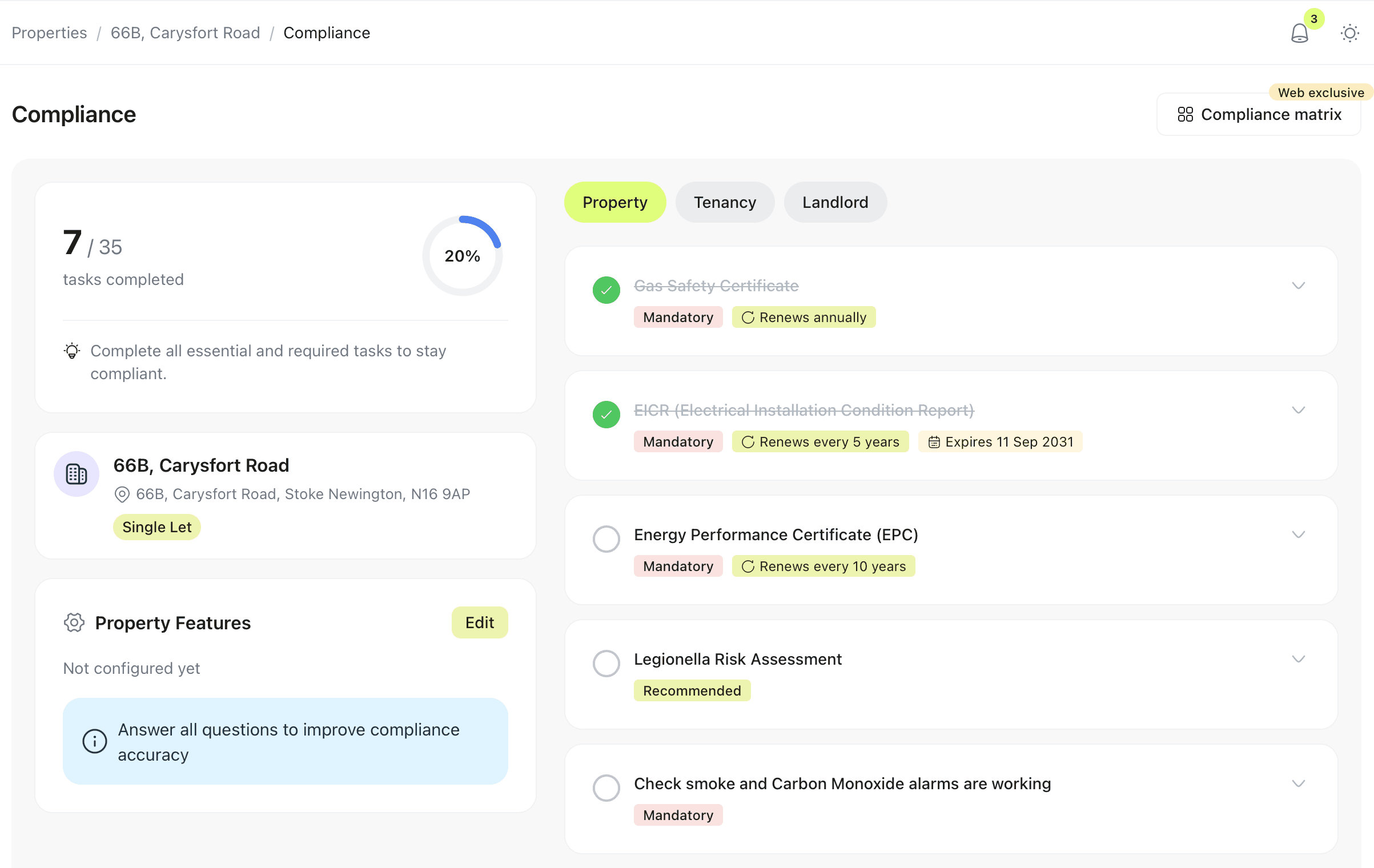
Compliance tracking has to reflect England, Wales and Scotland law rather than a generic imported template, and the certificates that matter here are gas safety, EPC, EICR, Right to Rent, deposit protection and, where applicable, HMO or selective licensing. The core duties are annual gas safety checks under the Gas Safety (Installation and Use) Regulations 1998, with records kept for two years and a copy given to tenants within 28 days; five-yearly fixed-wiring inspections under the Electrical Safety Standards in the Private Rented Sector (England) Regulations 2020; and Right to Rent checks under the Immigration Act 2014 before the tenancy begins, retained for at least a year after it ends. None of that applies in Scotland, where the duties are landlord registration, the Repairing Standard with its five-yearly EICR, the private residential tenancy's written terms, and the notice to leave; our Scottish landlord guide lists them, and August's Scottish compliance journey tracks them.
The Renters' Rights Act 2025, in force since 1 May 2026, has made record-keeping consequential rather than merely tidy. With Section 21 abolished, possession runs through a Section 8 claim, and the mandatory Ground 8 route needs three months' arrears, or thirteen weeks where rent is paid weekly, evidenced by a clean timestamped record of missed payments and formal notices. Software that logs every rent event with a date in an auditable format is operational protection, not a convenience. The Renters' Rights Act hub covers the Act in full, and if compliance is your deciding factor our best property compliance software comparison is the focused version of this section. A good document store keeps certificates, prescribed information and deposit confirmations together with their expiry dates.
Making Tax Digital: what to check before you rely on a tool
Making Tax Digital for Income Tax is live, and the question is no longer whether software keeps digital records but whether it has produced a submission you were willing to send. Landlords and sole traders with qualifying income above £50,000 came into scope on 6 April 2026, and the first quarterly update was due by 7 August 2026. The next falls on 7 November 2026, then 7 February and 7 May 2027. The £30,000 threshold joins in April 2027 and the £20,000 threshold in April 2028, so if your income is near any of these, MTD readiness should weigh heavily.
Check three things. First, whether the platform appears on HMRC's recognised-software list, which is a public register and takes a minute to search. Second, whether it submits directly or only exports for someone else to submit. Third, whether it keeps records per property rather than in aggregate, because an aggregate record cannot be split back out at a deadline. August is recognised by HMRC for MTD for Income Tax covering UK property income and is listed on the GOV.UK software list. Our Making Tax Digital for Income Tax guide covers the obligation itself, and the best MTD software for landlords comparison covers the tools. If you want the unfiltered version, what landlords say about running MTD through August is worth more than our description of it.
How much does property management software cost in the UK?
UK property management software costs most self-managing landlords between £0 and £40 a month depending on portfolio size. Entry-level tiers run roughly £0 to £15 a month at one to five properties for core rent, compliance and document features. Between five and thirty properties it runs £15 to £40 once AI, bank feeds, maintenance and accountant tools are added. Agency-grade systems start around £40 and pass £100 for multi-user access, client accounting and works orders, which is beyond what a self-managing landlord needs.
What is the best free software for landlords in the UK?
Four of the twelve have a free tier a landlord with one or two properties can run on indefinitely, and one is free outright at that size. August's Free plan covers two tenancies with no time limit: rent tracking, expense logging in HMRC categories, the compliance checklist, document storage, reminders and the tenant app; Open Banking feeds and MTD filing need Growth at £8.99 a month. Landlord Studio's free tier is limited to manual entry with no bank feed. Alphaletz's Always Free tier covers three units without bank connectivity. Rentila is free for one unit with two tenancies and £4.90 a month beyond that. Lendlord gives away most of its features but is a finance tool, not a tenancy one. LetSorted's first property is free but its later pricing is not published. The line where free stops being enough is the third property or the first MTD deadline, whichever comes first: none of the free tiers files a quarterly update, and only August's includes a guided compliance workflow. Our free landlord software guide sets out each provider's free tier line by line.
Does it help with self-assessment?
Good software categorises income and expenses by HMRC category, produces property-level profit and loss rather than an aggregate figure, exports in a format an accountant can open, and pulls transactions from a bank feed so you are not typing them. August's reporting is designed for accountant hand-off as standard. To be even-handed: Landlord Vision goes further on the finance side with detailed profit-and-loss statements and accountant read-only access, and Hammock adds automated reconciliation and HMRC-ready summaries. If accounting is the whole of what you need, our comparison of property management accounting software covers the category on its own terms.
Everyday features worth checking
Rent tracking and arrears. Payments should match automatically to the right tenancy, partial payments and arrears should be flagged, and exports should need no reformatting. Our best rent tracking software for UK landlords goes deeper on that one job.
Maintenance logging. Log an issue, assign a contractor, keep the tenant informed, store the documentation. August keeps maintenance simple for small portfolios with timestamps, photo uploads and an audit trail, without the weight of a full works-order system.
AI assistance. August Intelligence answers questions about your own data, such as how often a flat has paid late this year, and reads a tenancy agreement to suggest the details during onboarding. Most of the 2026 entrants now offer something comparable, so judge it on whether it works on your data rather than on whether it exists.
Mobile parity. The phone experience should do what the desktop does, not a cut-down version. Expense capture, certificate checks during viewings and tenant messaging all happen away from a desk. If you also want your tenants in an app, our guide to tenant-facing apps covers that side.
How to make your shortlist
Write down five non-negotiables. For most self-managing landlords these are automatic rent tracking, UK compliance checklists, certificate expiry reminders, a maintenance log and something that helps at year end. If a platform misses one, move on.
Run two live tests in each tool: add a tenancy with six months of rent history, then log a maintenance issue with a photo and close it. If either feels clunky in a trial, it will not improve in production.
Check the UK detail: deposit protection, prescribed information, Right to Rent and, if relevant, HMO licence renewals.
Probe data portability. You should be able to export properties, tenancies, transactions and documents without raising a support ticket.
Invite your accountant. Does the platform offer read-only access, and are the statements clear enough to hand over without explanation?
Implementation tips
Migrate what matters first: current tenancies and the current tax year, archiving older documents separately. Standardise property naming from day one so filters and reports stay clean. Set up rent due dates, arrears triggers, tenancy-end notices and certificate reminders before anything else. Pilot with one property through a full rent cycle and one maintenance workflow before moving the rest across.
Frequently asked questions
What software do landlords use in the UK?
Most self-managing landlords still use a spreadsheet, a bank app and an email folder; a minority use dedicated software, and that minority is growing because Making Tax Digital now requires digital records. Those who do split between accounting-led tools, Landlord Vision and Hammock, and management-led tools, August, Alphaletz and Landlord Studio. Letting agents use a third group, Arthur Online, Reapit or Jupix, built for client accounting.
What is property management software?
Software that manages the running of rental properties: rent matching, compliance certificate tracking, expense recording, document storage and maintenance logging. For a self-managing landlord it is the same category as "landlord software"; agency-grade systems add client accounting and works orders.
How much does property management software cost in the UK?
Free to £15 a month for one to five properties, £15 to £40 for five to thirty, and £40 to £100+ for agency-grade tools. August, Landlord Studio, Alphaletz and Rentila offer free tiers; Landlord Vision, Hammock and Arthur Online do not.
What is the best property management software for UK landlords?
There is no single best tool, because the right choice depends on portfolio size, financial workflow and compliance needs. For self-managing landlords who want UK compliance, rent tracking and MTD in one place, August is built for that brief. For deep accounting, Landlord Vision is stronger. For larger HMOs and agency-style workflows, Arthur Online scales further. Test two on your own data before deciding.
What is the best property management software for small landlords?
For one to five properties, a landlord-first app with a free tier, automatic rent matching and document-driven expiry reminders, costing £0 to £15 a month. August, Landlord Studio and Alphaletz all offer free tiers at this size. Landlord Vision, Hammock and Arthur Online do not, so you would be paying before you could test.
Is it worth it for just one property?
Usually yes. One buy-to-let still carries gas and EICR renewals, deposit deadlines and year-end expenses, and automated reminders tend to save more than the subscription costs in avoided fines and accountant time. A free tier is worth trying at one property; a paid plan usually justifies itself from two or three.
Does property management software handle Making Tax Digital?
Most keep income and expenditure organised by property and export clean records, but only some submit to HMRC directly. Landlords with qualifying income over £50,000 have been in scope since 6 April 2026, with the next quarterly deadline on 7 November 2026. Check HMRC's recognised-software list before relying on any tool for a submission.
Is August suitable for Scotland or Wales?
Wales is close to England for most software, with Rent Smart Wales registration and occupation contracts as the differences. Scotland is a different regime: the private residential tenancy, compulsory landlord registration, the notice to leave with 28 and 84-day periods, the First-tier Tribunal instead of a court, and the Repairing Standard. Of the twelve tools here, August is the only one that runs a separate Scottish compliance journey; Hammock is recommended to Scottish Association of Landlords members for accounting; the rest track expiry dates without nation-specific rules. Check for PRT tenancy types and Scottish notice periods before buying anything else.
You can compare August's plans to see what is included at each tier.
About August
August is an all-in-one property management app built for self-managing UK landlords, bringing rent tracking, compliance checklists, document management, smart reminders, expense tracking and an AI property assistant into one mobile and web app, without the complexity or cost of agency-grade systems. It carries separate compliance journeys for England and Wales and for Scotland, and is built for portfolios of any size.
This article is general guidance, not legal or professional advice. August has a commercial interest in this comparison as one of the platforms reviewed. All pricing and feature detail was verified on 26 September 2026.

Author
August Team
The August editorial team lives and breathes rental property. They work closely with a panel of experienced landlords and industry partners across the UK, turning real-world portfolio and tenancy experience into clear, practical guidance for small landlords.